In the nearly 20 years I’ve been working in e-commerce business and technical solutions, I’ve regularly encountered business owners who feel overwhelmed by the technical options available for their e-commerce sites.
All too often, their technical decisions when launching or revamping their e-commerce sites are based on what’s available on the market rather than on their actual needs.
This article aims to shed a different light on the selection and, more generally, the comparison of e-commerce solutions, in order to help SME owners active in e-commerce make informed choices and maximize the chances of success for their e-commerce launch or migration projects.
First, why distinguish between “software” and “platforms”?
For over a decade, the global IT market has been pushing for platform-based solutions rather than royalty-free or licensed software. Is this a sound approach, or is it a bias promoted by platform providers? For over a decade, the global IT market has been pushing for platform-based solutions rather than royalty-free or licensed software. Is this a sound approach, or is it a bias promoted by platform providers?
Today, the trend promoted by the IT market is indeed to subscribe to services rather than invest in purchasing licenses. In practical terms, IT offerings—including e-commerce tools for setting up an online store—provide two options in a “subscription-based” model:
- SaaS (Software as a Service): this involves renting a license rather than purchasing it,
- PaaS (Platform as a Service): this involves bundling software with hosting to create a “ready-to-use” solution,
Alongside this “cloud” approach (SaaS or PaaS), the more traditional method involves purchasing software (or using open-source software) and hosting it yourself. In this case, the e-merchant breaks down PaaS into layers (hosting, e-commerce, SEO, etc.) and handles the implementation of these layers themselves (with partners).
This approach of bundling a tool with hosting represents a trend distinct from that of royalty-free software. Unlike software that is billed (either through purchase or subscription), royalty-free software has gained significant market share in recent years, including in e-commerce, with excellent, fully mature tools that do not involve monthly usage fees.
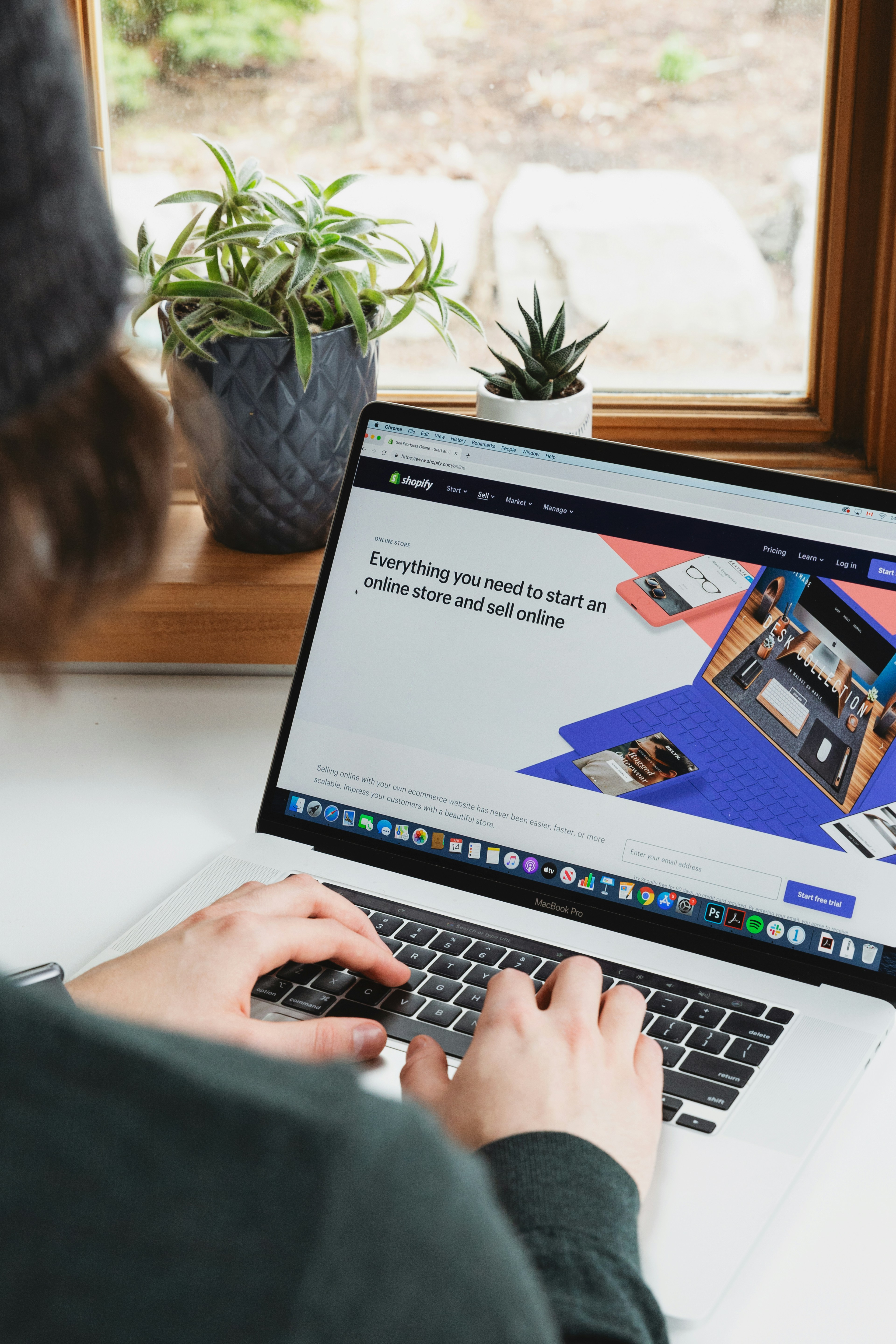
- Platform (PaaS): Shopify, WIX
- Software: Magento, PrestaShop, WooCommerce
- Some hosting providers offer software in the SaaS model, i.e., by bundling hosting with royalty-free software—for example, WordPress and WooCommerce pre-installed on a hosting plan
Advantages and disadvantages
Advantages of Software:
- The e-merchant “owns” rather than “rents” their e-commerce site. This approach should therefore be viewed as an investment on par with machinery or warehouses. The return on investment will come later, but it will be long-lasting,
- This approach is both “off-the-shelf” (when the software is implemented in a standard way) and “custom-made,” since the e-merchant can decide at any time to upgrade the software’s features to enhance it and set themselves apart,
- All functional needs can be accommodated. In theory, it’s a “sky’s the limit” approach, even though we all know that in practice, an SME is constrained by a budget.
Disadvantages of Software:
- The initial investment cost is generally higher than that of a platform, even with open-source tools. In fact, , you’ll need to work with an agency to deploy the software and implement e-commerce features, configure shipping carriers, add payment methods, and so on. When the solution is significantly enhanced compared to the software’s base version, operational costs may be high to maintain overall balanced operations over the long term. This is also the case for platforms,
- The risk regarding the software provider’s viability—whether the solution is open-source or paid—is similar to that for platforms.
Advantages of platforms:
- They are “ready to use”: launching an e-commerce site has never been faster,
- They combine a set of features and business logic into a “ready-to-use” or “turnkey” solution. The e-commerce merchant benefits from a series of processes and best practices natively integrated into the platform,
- They offer attractive pricing for e-commerce merchants just starting out: the upfront investment is low (pre-packaged, ready-to-use platform), and operational costs are minimal at launch with a basic solution.
Disadvantages of platforms:
- It’s always “off-the-shelf”—that is, a standardized version common to all customers. This is the opposite of a “custom-made” solution; in other words, if the “off-the-shelf” solution doesn’t fit, then it’s not an option,
- All potential competitors using the same platform therefore have the same tool at their disposal. Thus, in terms of the features offered, there is little or no differentiation among e-commerce operators, which shifts competition to factors such as price and inventory. It’s important to be aware of this. We’re all going into battle with exactly the same weapons,
- It’s still possible to build on top of the platform using components or custom development to create a unique offering and richer functionality. However, this is more difficult to achieve, and there’s a risk that the features you’ve developed won’t be compatible with the next version of the platform. We see the same type of issue with ERP platforms like Odoo,
- If the e-commerce business decides to terminate its contract, it loses everything: its e-commerce site, its SEO rankings—it’s back to square one. In most cases, it can retrieve a list of customers and orders, but that’s usually where it ends,
- These platforms become costly when you move beyond the standard plan or as sales volumes increase. Some platforms charge a commission percentage on e-commerce transactions. This is the case with Shopify Plus, whose pricing starts at over €2,000 in monthly subscription fees, plus commissions,
- There’s always a risk regarding the sustainability of the software provider, which could be acquired or face quality issues or financial difficulties—though this is true of any software provider.
Once the differences between “platforms” and “software” are understood, a new or already operational e-commerce business owner is better equipped—but not yet sufficiently so to make an informed choice. By “informed,” we mean “one that maximizes the chances of success for their project,” because ultimately, that’s what matters most to them!
So how can you make a smart choice between these two alternatives and all the products available?
Here’s a proven, four-step method:
- Defining the requirements for the e-commerce business owner’s specific project
- Functional specifications, or the list of functions the future e-commerce site must fulfill
- Differentiating technical solutions based on functional and technical requirements
- Market consultation, shortlisting, negotiation, contract finalization, and project implementation.
Here is a summary of the process, carried out in four successive steps.
The choice should not be based on the specifications of each software candidate or platform, but rather on a clear articulation of the e-merchant’s actual needs. It is therefore essential to avoid this mistake and reverse the approach. First, identify what the e-merchant needs before looking at what the market has to offer!
This assessment of needs depends on multiple factors:
- The e-merchant’s stage of economic and commercial development: Is the business a startup (in need of market validation), or a newcomer looking to grow (with initial recurring sales already in place and growth as the primary need), operating in a mature market, a niche market (whether protected or not), etc.? This “business” context will already provide insights to help choose the right solution,
- The current state of competition in the e-commerce market, both online and at retail locations. This therefore covers offerings already on the market, available warehousing services (directly through the competitor, via marketplaces, via dropshipping, etc.), and competitors’ delivery offerings—both in terms of delivery pricing and associated logistics (delivery time, tracking, options available to the end customer),
The preceding elements will help define the marketing and functional specifications for this e-merchant’s online offering at a given point in time.
Here are the typical questions to ask during this analysis in order to be able to write down a precise, structured list describing what the new site must do. These lists are generally accompanied by priorities (mandatory, optional, possible).
- Which products should be offered, in what format, and paired with which services? For example, a product configurator may be needed so that customers—whether B2C or B2B—can use a self-service mode to determine what they need to purchase to meet their own needs. The same applies to product variations (e.g., variations by size, color, etc.), products with free variants, or digital products, as well as combinations of physical and virtual variations (e.g., print, e-book, and audiobook editions).
- What kind of inventory management is necessary to stay competitive? Examples: the size of the merchant’s own inventory with shipping within X hours, single- or multi-warehouse management, dropshipping from the e-merchant’s supplier, made-to-order with restocking, etc. Similarly, should inventory be shared in real time with one or more retail locations?
- What price range should be offered? Do market conditions and competition require the e-merchant to offer volume discounts, a loyalty card to accumulate discounts, “buy four, pay for three” promotions, discounts based on quarterly purchase volume, guerrilla marketing, etc.?
- What shipping options should be offered to the end customer for delivery? Typically, should you offer delivery to the home or office, to a pickup point, to lockers, on pallets, while accounting for volumetric weight, and by offering a variety of carriers so that the end customer can choose their preferred carrier to deliver to their home?
- What payment options should be offered? For example, via bank transfer, credit card, depending on each country’s specific requirements (e.g., Bancontact in Belgium, My Bank in Spain or Italy, PayPal), as well as installment plans (“buy now, pay later”) or payment after delivery and invoicing?
- What safeguards should the new e-commerce site include? First and foremost, it must fully comply with applicable laws in Europe and in the e-merchant’s country. There’s no question about it: not only must the e-merchant operate within the law, but in this age of scams, savvy customers will verify the presence and accuracy of various details on the site where they plan to make a purchase—such as compliance with the GDPR, cookie management, handling of online cancellation requests, and country-specific requirements (e.g., Germany), among others. This may seem naive, but not all e-commerce platforms are equal under the law in this regard…
- Other factors, such as the need to integrate a point-of-sale system with an existing e-commerce platform or to handle online invoicing according to the European Union’s Peppol standard, may be mandatory features for certain e-commerce businesses.
Defining these requirements certainly does not mean “checking all the boxes.” In practice, for small and medium-sized businesses (SMEs), the e-merchant’s budget is undoubtedly limited. The e-merchant must therefore focus on the features that are essential to achieving their business objectives. Here, too, it may seem like stating the obvious, but aligning needs with available investments is no trivial matter.
Based on this structured list of functional requirements, the e-commerce business can then select a shortlist of potential tools for its new e-commerce platform and subsequently explore the market.
The technical response to functional requirements can take one of three implementation approaches. These are often referred to as “adopt, adapt, or develop”—three methods for meeting requirements with a software solution or e-commerce platform. You’ll soon understand.
We won’t dwell on this step, even though it’s critical. It would require an article as long as the one you’re reading, and I wouldn’t want to lose the reader’s attention.
Typically, this step is based on functional specifications, as well as non-functional requirements and a series of administrative clauses, in order to
- conduct a structured and fair market consultation,
- Receive bids,
- Compare them,
- If necessary, ask one or more candidates to build a prototype to demonstrate what they claim in their bid,
- If necessary, visit the bidders’ reference sites,
- Negotiate,
- Define billing and payment milestones (to maintain control of the project),
- Finalize a contract and sign it
- Manage the project until you are satisfied.
Let’s never forget that as long as the contract isn’t signed, it’s still possible to make demands of a prospective supplier. Not so after it’s signed. Finally, a good market consultation should result in a contract that both parties trust and that will ensure the project meets the CQFD criteria: a project delivered at the planned Cost, with the defined Quality, all the Features listed in the requirements specification, and within the allotted Timeframe. That’s quite a story. Here, too, we could go into great detail about why digital projects—in SMEs, but not only there—can (often) fail.
These four stages involve a considerable amount of preparation, as well as specific skills.
In principle, unless this is the e-commerce manager’s role, the business owner is ill-equipped to navigate this four-step process smoothly. As a reminder, these steps are: (i) defining requirements, followed by (ii) identifying the best solution among ‘adopt, adapt & develop’, (iii) market research and of the right partner (skills and ‘fit’), and finally (iv) implementation of the roll-out or migration project.
It is never advisable to rely on a development team to help a business owner make decisions. It sounds tempting: ‘But of course, we know e-commerce inside out; it’s our job to set these things up – just put your blind trust in us! ’ The development company will very quickly become both judge and jury and, in 99 out of 100 cases, will prioritise its own interests at the expense of those of the e-commerce client.
So what should you do? There are consultants who specialise in this field, whose aim is to support the e-commerce business owner throughout the planning and implementation process, presenting a range of solutions tailored to their needs, guiding their decision-making and ensuring the best possible chance of success for the resulting project, at the most cost-effective price. A consultant worthy of the name is completely independent and impartial, and will look after the interests of both the e-commerce retailer and the supplier, because their aim is to ensure the project is successfully completed with a solution that will be profitable for their e-commerce client.
All this may seem theoretical, but it is still the right approach to taking when choosing the right tool to ensure the success of your next e-commerce venture. Let’s now look at this from a practical perspective.
Are there any specific examples of the varying needs of e-commerce businesses that influence the choice of a solution?
Case study #1. The start-up founder launching a new business is in the process of validating their approach.
They are asking themselves questions such as:
- Is my product marketable?
- Can the business I want to set up survive the competition?
- How am I going to organise my logistics?
- Etc
In all these cases, the start-up is in a learning phase, whether limited or extensive.
At this early stage of its e-commerce journey, it is best for the start-up not to make restrictive choices that could prove to be dead ends in the future.
Clearly, in this case, either this start-up wants to keep its costs to a minimum and will opt for a platform-based solution to test its business model, or it is averse to the idea of ‘renting’ its platform and prefers to start with an inexpensive software solution on a ‘100 per cent adoption’ basis, whilst retaining ‘ownership’ of its e-commerce site.


Case study #2. The e-commerce business owner who feels held back by their current technical solution at a time when their business is growing or they are considering new features to drive further growth.
This is the case when it is essential for the system to integrate with the retail outlet’s ERP system to prevent the online sale of out-of-stock products, or when the retailer wishes to set up specialised product comparison tools or develop a product selector, etc.
In this specific case, the e-commerce retailer already knows their business model; it’s a business that’s already up and running. They must now focus on the technical aspects of rolling out new features. They know their market and their customers. They want to provide specific solutions to specific needs.
There are several different ‘migration’ scenarios:
- If their e-commerce site currently runs on a platform: either the platform can provide technical solutions to their functional requirements (adopt) at a competitive price, or it cannot,
- If their e-commerce site uses open-source or off-the-shelf e-commerce software: the same scenario applies, but this time the question is whether their service provider can ‘customise’ their e-commerce software to incorporate the new features at a competitive price, or not
In both cases, if the answer is ‘no’, the e-commerce operator should then survey the market to identify which ‘adopt’, ‘adapt’ or ‘develop’ solutions can meet the new functional requirements at the desired price.
It is therefore potentially at a pivotal stage in the process of changing its e-commerce solution, with a migration on the cards. This may also be the case when the e-commerce site’s software solution is based on bespoke development that is reaching the end of its life cycle for technical or functional reasons. This is a typical scenario for projects carried out between 2010 and 2015.
Final question: what do the statistics – both in Europe and internationally – reveal about the choice of e-commerce solutions?
Here is another way to gain a practical insight into what the market is doing: market share statistics.
There are several ways to look at the market share statistics for each e-commerce tool. Let’s consider the issue from different angles so that we can gain a clear understanding and remain impartial.
In terms of the number of websites, globally, the Shopify platform (basic version) and WooCommerce are far ahead. Next come e-commerce platforms such as Magento, PrestaShop, Shopify Plus and Shopware (source: W3Tech 2026):
Marketshares of e-commerce websites (wordlwide, in %)
- Woo Commerce
- Shopify (Basic, no the Plus version)
- PrestaShop
- Magento (Adobe Commerce)
- Woo Commerce
- Shopify (Basic, no the Plus version)
- PrestaShop
- Magento (Adobe Commerce)
Marketshares per country (in %)
- Woo Commerce
- Shopify
- Prestashop
- Magento / Adobe
- Shopware
- Wix
- Woo Commerce
- Shopify
- Prestashop
- Magento / Adobe
- Shopware
- Wix
If we look at Europe alone, this needs to be analysed from a sub-regional perspective, at the level of each individual country.
There are, in fact, geographical disparities that distinguish the markets from one another. This enables us to refine and better explain market shares (Source: Plug2Data – CMS e-commerce market shares by country).
Beyond market share figures, which treat all websites as equal, the most interesting statistic comes last: that relating to the turnover generated by the various solutions discussed in this article. This reflects a more considered approach, tailored to the needs (and the stage of development) of each e-commerce business.
E-Commerce Nation analysed these figures in 2026 for the French market. Here are the main conclusions of their report:
- 512 e-commerce sites analysed,
- 661 businesses identified based on their company registration number,
- 89 per cent of the market concentrated on three CMS platforms: Shopify, WooCommerce and PrestaShop,
- 68.1 per cent of websites are based on open-source software,
- €7.96 billion in turnover for e-retailers using PrestaShop,
- €5.76 billion for Shopify (basic and Plus versions combined),
- €4.79 billion for WooCommerce,
These cumulative turnover statistics by platform clearly confirm what we outlined above: Shopify has a massive market share amongst start-ups venturing into e-commerce, whilst PrestaShop (the market leader in France) is the go-to choice for well-established e-commerce sites that are now running at full speed.
PrestaShop (which publishes the software in both an open-source version and a SaaS version) has previously stated that its core target market consists of businesses aiming for an annual turnover of at least €1,000,000.
Turnover for the eshop managers (€ billions)
- Turnover
- Turnover
Turnover achieved (july 2026, in %)
- Turnover > € 10 millions
- Turnover between € 1 and € 10 millions
- Turnover < € 1 million
- Turnover > € 10 millions
- Turnover between € 1 and € 10 millions
- Turnover < € 1 million
FEVAD is the French Federation of E-commerce and Distance Selling. It publishes annual market figures on e-commerce in France. These include this interesting breakdown of websites by turnover (July 2026):
- 1.2% of websites generate turnover of more than 10 million euros,
- 6.5% of websites generate turnover of between 1 million and 10 million euros,
- 92.4% of websites generate turnover of less than 1 million euros,
Taking the top brackets together, this means that just over 7.7 per cent of e-commerce sites in France reach or exceed the threshold of one million euros in annual turnover.
In the top segment of clients with turnover in excess of one million euros, according to global statistics from W3Techs, Shopify Plus powered 115,773 e-commerce sites in 2026, whilst PrestaShop powered 167,213 sites and Magento (Adobe Commerce) 175,389 sites.
There is no such thing as an ‘Swiss Army knife’ of e-commerce. In other words, the ‘one size fits all’ does not apply to e-commerce tools. I hope you’re now convinced.
Before being swayed by the market’s latest fads or offers backed by aggressive or flashy marketing, it is essential to focus on the needs of the future website in order to better assess which tools are genuinely relevant, using a tried-and-tested methodology and, where appropriate, with the help of a specialist consultant.
The Right Move (TRM) has both a consultancy team and a development team specialising in e-commerce solutions based on PrestaShop and WooCommerce software. For clients already active in e-commerce, TRM prefers to implement solutions where the client owns the system (as an investment) rather than rents it, primarily with a view to building a long-term partnership.
Christian Janfils has been an e-commerce consultant for SMEs for over 25 years, following a corporate career with world-class IT and telecoms service providers.
Feel free to contact us for a no-obligation consultation regarding your e-commerce enquiries.
 Christian Janfils